Once upon a time, there lived a poet
Even a child knows there are a million poets in the world, maybe even more. But this poet, whose last name was Durakov, lived completely alone. In the whole wide world, there was no one who loved him, no one who cared for him...
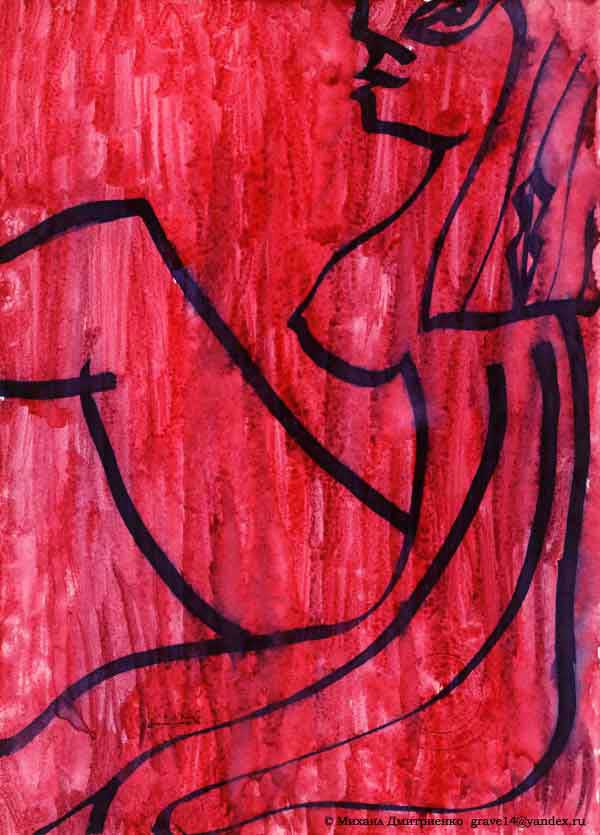
And so sad he was on long winter nights, so he suffered that no one could speak to him. He lived far, far away, on the very edge, and with each passing year, he retreated further and further from all the cruelly encroaching, indifferent people. He sat alone, looked at the stars, and wrote his poems — known and unneeded by anyone. But one day, on the sunniest day, sitting on a high hill in the middle of a wide, green field, he accidentally saw a beautiful girl. He rarely saw beautiful people, and seeing her broke his heart. And the girl smiled at him and waved her little hand. He rushed toward her, but she melted into a blue cloud. And the next day he came and sat for a long time on a high hill in the middle of a green field. He saw the beautiful girl again, and again she smiled at him and waved, and again he rushed toward her, and again she disappeared. For many days, he came to this high hill, and everything was repeated again and again. And at night, he wrote and looked out the window at the stars.
And no one read his poems, as before, and what he thought about while looking at the stars, no one knew, and, frankly, no one wanted to know. But he wrote about love, he wrote about the people he loved. He wrote about what he had never seen and what he had never known. And if people had read even one of his poems, they would have understood how much they needed him, if only they would take a step toward him and a step toward millions of others, perhaps not poets at all...
But a step is worth a lot, and not everyone is willing to sacrifice their step for the sake of something unknown — someone's words, someone's dreams... And it became more and more painful for him — he noticed, it seemed to him, that the beautiful girl, time after time, was becoming less beautiful. And then his broken heart would silently scream in unbearable pain, and then he would fall at the place where she disappeared, and remain silent in despair. And the more the wind tore the beautiful girl's beauty from her, the more beautiful his dreams became, the more his heart ached, and the sadder his poems became, and for long, long nights the stars wept with him.
And one day, the beautiful girl didn't appear. She didn't appear the next day, and the next... For a long time he walked, for a very long time he looked from a high hill onto a green field. For a long time, he gazed at the stars at night... But the girl never appeared again, and all the stars suddenly fell silent, and not a single person took a step toward him. And then he died.
Everyone, even a baby, knows that if people die, they die of melancholy. And yet, one day, the beautiful girl smiled again and waved again, only to the empty hill. And the stars gazed for an eternity into the empty, black windows.
But people didn't care; they didn't care about this poet, of whom there are millions. They never read a single one of his poems. And they never learned what he dreamed of or how he loved, and, frankly, they didn't want to know. And they weren't particularly upset to learn that one poet had died, and the stars looked down indifferently from their cold heights. And the beautiful girl was probably upset — she liked it so much, and she was so used to smiling at the fool on the hill and waving at him. But her upset didn't last long — after all, there are other distances and other spaces, and countless hills and millions of fools on the hills. And, after all, there are much more unhappy people. And, after all, you can't be unhappy your whole life. And, after all, she didn't love this poet. And, after all, it was her everyone loved, not him. And that's fair...
1998 Mikhail Dmitrienko Alma-Ata |
